Saturday, October 19, 2013

11 October Tirana - Tirana Airport – Brussels’ Airport – Turnhout - home


With the help of the security guard of the hotel, my pedals are loosened. When I come down after my breakfast the job is finished. Also the lady host of the hotel has bargained a good prize per taxi for the trip directly to the airport.
After warm goodbye’s, I decide to take off for Albania airport. We arrive at 11.00 a.m. and the check in counter will only open up at 14.00 hours. I sit outside, in the morning sun, drink a coffee and work on my blog.

The bicycle, which I have wrapped in cardboard and taped myself, is not properly packed. So I decide to have both packages plastic wrapped. After some bargaining with the guys running the machine we agree on two packages for the price of one.

I check in my bicycle and hope for the best. We will see how it will come out in Brussels’.

The trip goes according to plan and it gives me time to think my bicycle adventure over. Some of these thoughts, I will share with you in my concluding chapter.

The flight arrives in time. At Brussels’ airport I reassemble wheels, saddle and steering of my bicycle, after unwrapping the packages. I role the bicycle to he station, buy tickets to Turnhout.

 
I arrive at 21.00 hours and am re-united with my lovely wife Ameli. Happy to see each other again, we drive home. My trip has officially ended, but it will take some time to readjust to ‘normal’ life, whatever that maybe. But one thing I know for sure, every minute of this 6 past weeks have been worth the experience. It was just fabulous. I‘ll tell you why tomorrow.


Monday, October 14, 2013

10 October Tirana


In the morning I decide to try and find out about Tirana’s second year’s “Design Month”. According to the structure the Polis University should be the place to be.


At Skanderbeg Square the buses to this University seem to leave. After a coffee in bar I’ve two young economy students. One is so kind to walk me to the bus stop and tell the driver where I need to go. A single trip costs a little less than 0,20 €. Another succeeds the first bus escort. He walks me to a private business University. 

 Skanderberg Square in center Tirana
Friendly they tell me that the Polis University is some 5 kilometers away. Two students point me out another bus and even want to pay for my ticket! This kind of hospitality I have encountered all over Albania. People are proud of their country and want you to feel welcome. They are just fascinated that you come to visit them. I know this will not last forever, but this culture of making sure that you are well looked after is strong. I can give numerous examples and this makes Albania a warm bath, especially coming from the North Western European directness and business-is-business mentality.

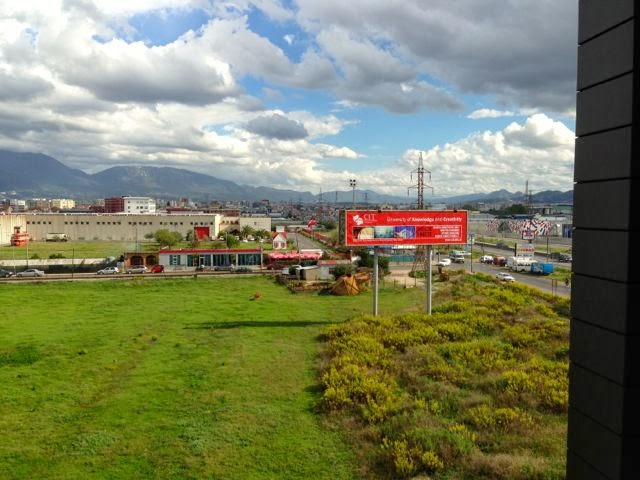
businesses and universities have moved to the outskirts
The Polis University has about 500 private students. One of the faculties is design. The three founding fathers of the Institute, started during their architectural and urban planning studies, with an NGO that was supported by funding from the Dutch Embassy, European Union and others. After they graduated, they decided to turn the NGO into a private school, which grew out into the Polis University. Four years ago they moved away to the outskirts, because the growing number of students couldn’t be 
housed anymore in the downtown building. They bought an old abandoned factory, stripped the inside and made it into a spacious and modern equipped educational center.

A staff member greets me and the young co-coordinator of the design exhibition shows me around. It appears that there are strong ties to the Erasmus University and the International Housing School (IHS) based in Rotterdam.
The design exhibition is tiny and could probably learn a lot from ties with the Eindhoven Design Academy and their graduation exhibition during the Dutch Design Week in Eindhoven in October.

wars in the Balkan and how they effected Albania
When I finally leave to take a bus back to Tirana’s Center, the guard taps me on the shoulder. He has been send after me to give me the brochure with presentations of their full program and exhibitions.

The bus takes me back and because my bicycle flies back home as well, I start gathering materials to firmly pack and wrap it. I have no idea if Tirana’s airport offers cardboard boxes or wrapping for bicycles. But I know from experience I need to dismantle by bike. The pedals off, air taken from the tires, etc.
I find cardboard, tape, but in the evening when I try to bicycle to a service station to ask if they can take the pedals of, the unavoidable happens for the first time this trip. An instant flat tire! A clear sign it’s been enough.

I’ll tackle this problem in the morning and go to dinner. I find a nice restaurant and receive some assistance to read the menu, by an Albanian speaking almost fluent German. After a short conservation about the beauty of the country and the friendliness of the people, I am again treated by a glass of red wine. It’s almost boring to mention but this is Albania at the moment. I feel a little sad, because I have come to the end of my beautiful bicycling trip, but it has been heart warming, interesting, rewarding and enlightening. Good night!


9 October bus Shkodra – Tirana


When I wake up it’s raining heavily. I decide to go to Tirana by bus. After thanking Martin and family members for their kind hospitality, I bicycle into town to bargain for a bus.
It’s crowded with people and there are many local bicyclists. There are even some bicycle racks. According to many I spoke to, Shkodra is the city where Albanians bicycle the most. I find the buses and even manage with the driver, to secure my bike standing up. That’s a relief, because it will come out all right with a much higher chance.

The bus takes me away from the rainy weather and into capital Tirana. When we reach Tirana’s main railway station the sun is shining. A hotel is found 200 meters down the street for a reasonable 15 euro a night.
It was good to take the bus, my bicycle could even stand up straight, and I prevented a trip along this busy road. I have been looking at the maps and after the experiences in the mountains so far, I will encounter still more and even higher passes when I try to reach the Igmoenitsa port in Greece, From there I can reach Istanbul by boat, but it will become a race against the clock and this I do not want. The road was my aim not the end destination. So after such a beautiful and inspiring trip I decide that Tirana will become the end station. I find a WIFI bar to start planning and preparing my flight back home.

That being taken care off, I enjoy the city, which comes to full life from around 15.30 till around 20.00 hours. It seems everyone is out on the street, going home from school, work or shopping for groceries, talking and having a coffee. At the Skanderberg Square, where the Opera and House of Culture are located and surrounded by many embassies, I run into a structure that says Tirana design month 15 September – 15 October. I decide I’ll find out more tomorrow. The Polis University seems to be the middle point of it all.
After asking for a restaurant with local food, I am escorted to a restaurant far away from one of the main arteries, Although you can’t enjoy city life, it’s better not to eat in the diesel fumes and the loud street noises. I enjoy some goat’s meet, a salad and another good local red wine. Tired, I put my legs up and fall asleep.

7 October Hotel Dardhe – Fushë-Arrëz – Rrapë - Pukë


After a long and refreshing night, I start at 9.45 and will see where it ends. I will not make it a long and tiresome day, because I still need to recover from yesterday and the days before.
At around two I arrive at Pukë. The forecasted rain is a little later and I arrive relatively dry at the hotel in the center. They ask a high prize and don’t seem particularly interested in me. Before I went in, a man in a small shop called out “Can I help you”. A first, I ignored this, but now I go back and realize he speaks good English. I ask him if there is an alternative for the Hotel. ‘Yes sure’, he answers. He knows a guesthouse, that he will call and ask for the prize and availability. A typical scene enrolls. He tries to reach them with his mobile. But apparently the phone-number of the place has changed. After some shouting over the square, another man walks up over to us. He greets me in English and it appears he worked two years in the UK and is now driving a taxi. He therefore has the correct telephone number. A call is made, a bed is available and I decide to go for it. A young man in a Landrover appears and waves to me to follow him. In less than a kilometer I arrive at ‘Hani’, a wonderful pension or guesthouse. However, it’s nowhere to be found via the Internet, besides a Facebook page. They have WIFI but no web page, which really is a pity, because they could attract many more tourists. You can make great hikes here, winter sports are also possible and trips by mini buses to other places of interest can be organized.

At 4, I eat the local bean soup, a salad and a bowl of rice. At seven I visit the downstairs’ restaurant again and meet with a hydroelectric engineer, fluent in English, 29 and married with a young child. He is an exception here, because he does neither smoke, nor drink. He also tells me that in Albania some years ago, even before France did, that forbids smoking in public places, restaurants and bars and is not allowed on the work-floor. But nowhere this law is respected or enforced. According to him this was just to make a good impression in Brussels.

Hani guesthouse
We exchange many thoughts, for instance about the development of this society, the need for a strong leadership and living with and caring for one’s parents. He reveals that Albania with around 3 million people – one million in Tirana – has many treasures. One is the abundance of water and the ability and need to increase the hydroelectric production. However, the relatively strong connection with the economies of Greece and Italy, are not in favor of current developments in Albania. A loan at the bank is almost impossible.
About strong leadership, he as a manager knows from experience, that people almost expect this. You can’t learn democracy by pushing a button. This reminds me of the other discussion with the army major some days ago, who was asking me if the politicians in The Netherlands were very rich. Asking this, revealed his thoughts: “They must be’, because ‘Hollanda’ is looked up to. When I tell him ‘No, if you want to become rich in the Netherlands, you’d better not become a politician, he laughs, obviously with unbelief. Nepotism in Albania is a widely spread disease!

The question is if the EU should not be stricter and wait longer before she invites these ‘young democracies’ into her midst and expects instant change and democratic behavior. You can change laws according to EU design, but what about the mentality of people and the non-existing checks and balances. Democracy is – as I see it – a historical and long-term construction that runs deep into the veins of the society and not something that is created overnight. This means that the generation of the clique of Enver Hoxha and the ‘new rich’, which have jumped into the wild capitalism stage, first need to vanish and grow up. A middle class requesting stability is badly needed, but this society is still far from it.

I believe that the twinning relationships, many cities in Western Europe built up in the former Central European states, were and are a superb vehicle to work on city and community level. They belong to a set of the strongest methods, next to supporting the NGO-community and independent journalism and student exchange, to bringing the awareness of democracy in all its ‘ins and outs’. After this trip that gave me a sniff of the Balkan states, I am quite convinced that a revival of this policy, EU-wide, could be of great assistance to unite our European worlds. It’s pitiful that so many Dutch cities have chosen to make deep cuts in these relative strong and cost efficient and promising relationships.


8 October Pukë - Shkodra


Did you know that the most popular car in Albania must be a second-hand Mercedes, and a filling station and the so-called ‘Car Lavazh’ (car wash), the most popular new smaller investments? You see the latter everywhere, popping out of the ground as mushrooms. Another phenomena are new buildings with names like ‘Europa Mobileri’ or ‘Mobileri Modern’, furniture for the newly built homes, because house construction sites for family houses you also see everywhere.
On my bicycle you see these things more clearly. The speed is not as great as in a car and the experience of landscape and surroundings are more intense.

From Pukë, it’s a fast decent for around 20 kilometers. I realize how high up in the mountains I have been and were. For kilometers I bicycle on a plain with only grass and small bushes, with on the left and right of me mountains up till 1600 meters.
I can’t find any rice waffles or gluten-free products, so I safe my Montenegrin packages.
In a bar in Kçirë, I stop for a coffee and get into a conversation with Martin Ded. The locals give me some fresh chestnuts, the bar owner serves me a free coffee. They all think I must be a little crazy to ride my bicycle from The Netherlands into Albanian mountains. Maybe I am!
Martin offers to take me up to the next top, but it appears his Land Rover is not big enough to carry my bicycle. A little later when I have climbed at least another 600 meters, he overhauls and inquires if I am all right. He invites me to his house in Shkodra. I agree and we meet again after the next decent. 
This piece of todays 60 kilometers is ‘Tour de Albania’ at it’s best. No car overhauls me here, dazzling down from hairpin to hairpin. I meet him again at the church and we drink another coffee and cola.
The next 20 kilometers Vau i Dejës to Shkodra are with headwind, but I do them in 50 minutes. It starts to rain more and more.

At the biggest Hotel in the center of Shkodra he meets me and I follow him to their family home. This is in a street unpaved and some 300 meters from the main asphalt street. The large houses with a gate bring back a memory from my Gedaref visits, although the ‘guard’ from there, is here replaced by a barking dog. But the call from the minaret for evening prayers is just the same.


Our conversations go on. He lives in Kristiansand Norway. Before he worked on an oilrig at Spitsbergen and made good money. In 1946 in the aftermath of the war a strange mix of communists and freedom fighters shot his grandfather, together and some village residents. His father and mother died both at around the age of 55. But they did everything to give him the best education. They all lived high up in the mountains in a family house. One of the landings during my boat trip from Koman to Fierzë was at the two-hour path up to his village, where today four families still live. At the local school he was treated with disdain and even beaten by the headmaster for the reason that their family saved some Jews during the 2nd WW. This was the method used to make people understood who had the power now.

As a young boy Martin had a dream about living in Norway. Where it came from he cannot trace. But he has realized it, being a Norwegian citizen now and living in Kristiansand. He holds the opinion that Albanians first need to come to their senses and realize that if they do not change their mentality, there is no reason others should reach out with a helping hand. My argument is that what you don’t know you can’t ask for or change into something else. We exchange thoughts.

One of his other stories, for what it’s worth, is that he was asked to work as a clerk for the municipality. After a half year, he quit because his ethics could not be in line with what was requested. He was asked to create new and false identities for several persons. He claims that there are Albanians, which hold at least three names and identities. They use this for doing business. It’s clear that this is corruption and illegal. For his own protection he has photographed the proof of this. It took him in total 3 days. Then he informed the authorities and he quit his job.

Tired of talking we go to bed and I'll just see if the weather tomorrow gets a little better.


Saturday, October 12, 2013

6 October Koman – Fierzë - Hotel at Dardhe


Host Klodian prepares my breakfast and makes absolutely sure my bicycle and luggage is safely secured on board of this peculiar ferry. It is a basic metal boat with on top the welded frame of a bus, plus the diesel engine of the bus. The steering and gas-pedal have stayed like if it were a bus.


host Klodian


On board there are some tourists, but mostly local people and of course the mail and all kinds of luggage. I meet with a French family, the two Germans and an 87 and 85-year old English couple who are accompanied by an Albanian tour-guide. He ‘s taking care of them, their hotels, food and travel. What a spirit to undertake these kind of trips at this age!


http://youtu.be/esIxwtQYy94

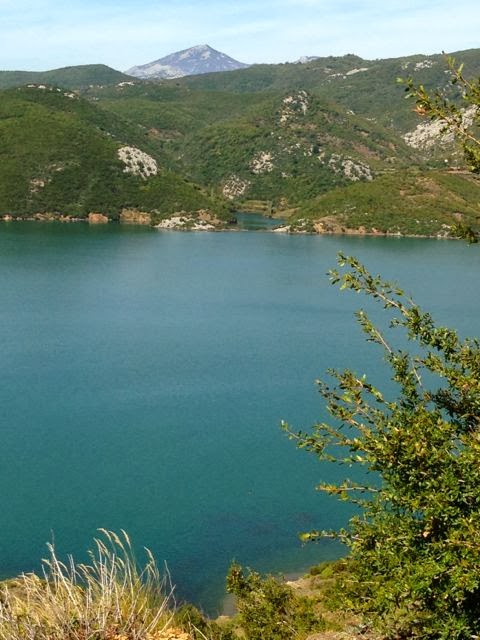
Every now and then the ferry makes a quick landing to let some local people off and take on some children, who must be on their way to school. Today is Sunday and they will be away for the week from their parents. The mountains are pure grey rock at the top and from the shores up covered by woods. These are the remote parts of beautiful Albania. This is a trip I will not easily forget. This boat is local ‘public’ transport, for some people who live on a 2 hour mountainous walk from the shores of the lake, somewhere high up there. The range is around 2000 meters high and once they set off on their ascend you can’t see them anymore after 10 meters.


At the next damn, we arrive in Fierzë, where the two real big car ferries lay ashore as stranded whales, rusting away.They used to transport many Kosovo cars, but since recently the new highway opened, these ferries went out of business.


I begin my bike trip at 12.15 not knowing yet what I am up to. Google maps and my paper map are just not good enough. I decide to eat first and at one p.m., I eat the best trout ever, grilled in the skin, accompanied by some fried potatoes and a sour salad. A good decision, because only 15 kilometers further and 600 meters higher, there is the first local bar.

Refreshed, I go for what I think will be a two-hour climb and 30 kilometers. I plan to arrive at 3 p.m. What a mistake that proofs to be! These are the heaviest 30 kilometers I've ever biked. Ascends very regular of 10% and then cutting back into the mountain 90 degrees, with some descend to cross a small river from a valley and turning 90 degrees at the bridge and climbing again. And this not once, not twice but at least 10 times. After asking several times how far my hotel is still away, I receive different answers. I am feeling insecure and am loosing my strength.
Giving in is something I don’t easily do, but at half past three and feeling exhausted, I flag down a Mercedes minibus. The man tells me that it’s another 9 kilometers to my designated hotel. I give in and ask him to drive me there. It costs me, but I am proud I made this conscious decision. As a 55 year old the mountains have beaten me, but God the ride was fabulous and made an impression! I will never forget it, as I won’t the rest of the day.
The hotel has Internet, food and a room and the prize is reasonable. I realize that after four tough days, for my relatively un-trained status, my body is short of energy. Salads, potatoes and meat are not giving me enough carbohydrates. My gluten deficiency does not help, because I can’t eat their bread. So after thinking this over, I am asking them to prepare me just bowls of rice, with some goat cheese and honey. I decide to have this for breakfast as well and will insist on repeating this. One can only come to the full appreciation of riders in the Tour de France after this experience. The amount of energy they burn during a day is so large, that you just can’t eat enough to meet the begin level. So it’s no wonder some riders loose 5 or more kilograms of body weight during the three weeks the Tour lasts.
The locals all go to bed early and I do too.
A rough estimation of this day is that I biked 30 kilometers, ended at 900 meters, coming from 150 and with all the ascending and descending the number of meters climbed must be somewhere around 1800. After realizing this, I collapse and at nine p.m. I am sound asleep.

5 October Mjedë - Lac I Qyrsac – Koman


This is by far the most beautiful and straining 40 kilometers of my journey up till now.

back road to lake Koman 

A real back-road leads to a dead end in Koman, location of the dam and a power station. The English lady from yesterday has recommended it and after studying and asking around, I have decided to go to Mario’s place. He is situated after the dam and from there I hope to take a boat on Sunday. 

bridge over the Drini River west of Kotor Lake damn

I can’t write much about this trip, besides that the landscape is beautiful, with many butterflies, some small farms and a local bar. Just look at the pictures and the link to get an idea.


In Koman there is a lot of lost glory after the new highway to Kosovo opened and the ferries went out of business. I cross the Drini River that fills lake Vau i Deges as well as lake Koman. Another 200 meters up, through a tunnel I stand at the lake Koman and the pension of Mario. The sun is on the other shore and it’s cooling down. The two hosts, Klodian (16) and Zef (25) store my bicycle. The latter speaks most English. I am the only guest for the night. The bed is basic, but there are enough blankets, the shower is warm and the food is plenty.
After giving them a round they start to loosen up and make great efforts to communicate. We share our music; pictures and we make the appointment for breakfast.
At six the place starts to fill up with workers at the hydro-electricity plant. We speak with hands and feet. My Spanish is the most helpful, because many older Albanians speak some Italian. There are plenty relationships, through Italian investors, temporarily work abroad and inter marriage. We laugh a lot, especially about the special police, what seems to be turned into private protection for the hydro plant and used to be Hoxha’s eyes and ears around the plant. They started building the dam and the work was finished after the change of power. On one of the pictures you can still see the concrete defense tower from those times.
Mario’s place promises a little more than in reality, but it’s off-season and there are but a few tourists.